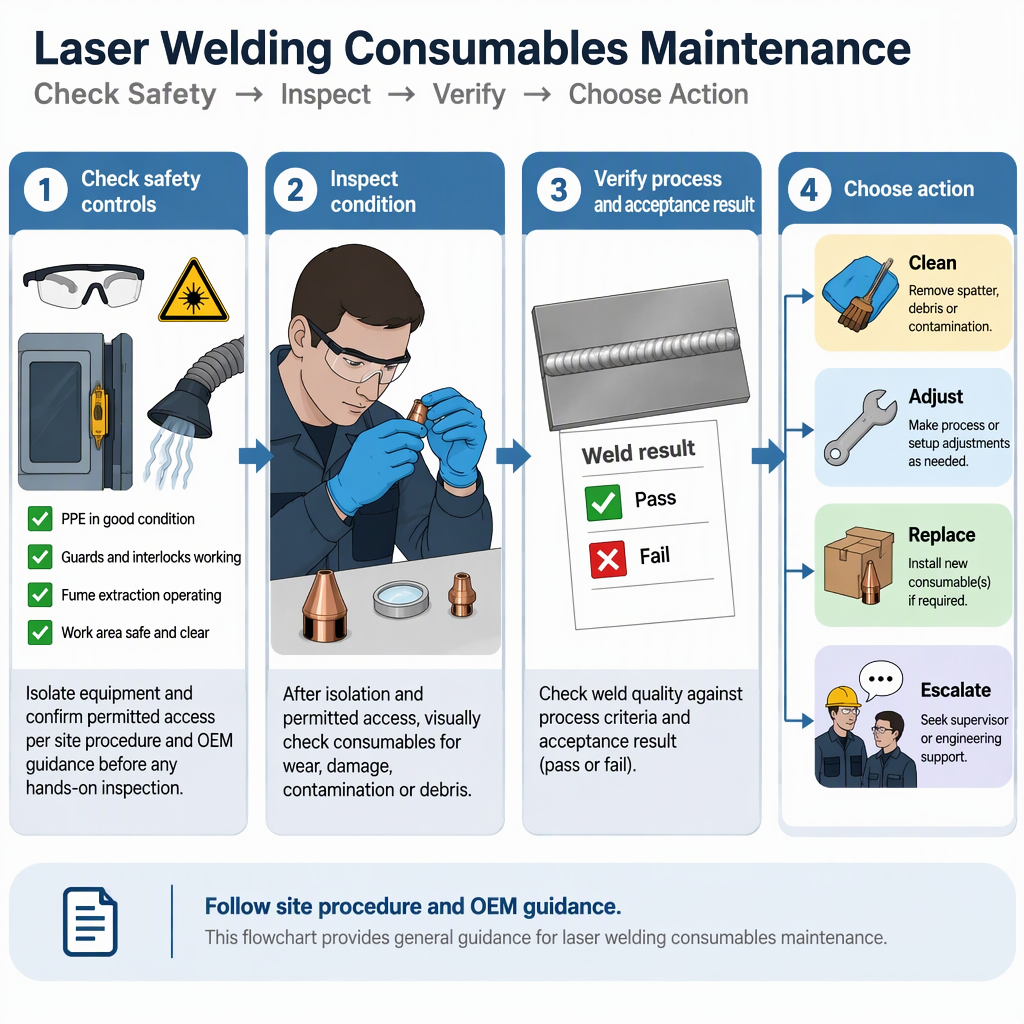
Inspect laser welding consumables whenever the manual requires it, after a process change, before acceptance-critical work, and whenever weld quality, fit-up, spatter, shielding, or operator observations suggest the beam path or shielding path may no longer be stable. Replace a consumable when cleaning or adjustment cannot restore the required result, and keep model-specific intervals, cleaning methods, and acceptance limits tied to the machine manual and your process qualification.
What counts as a laser welding consumable?
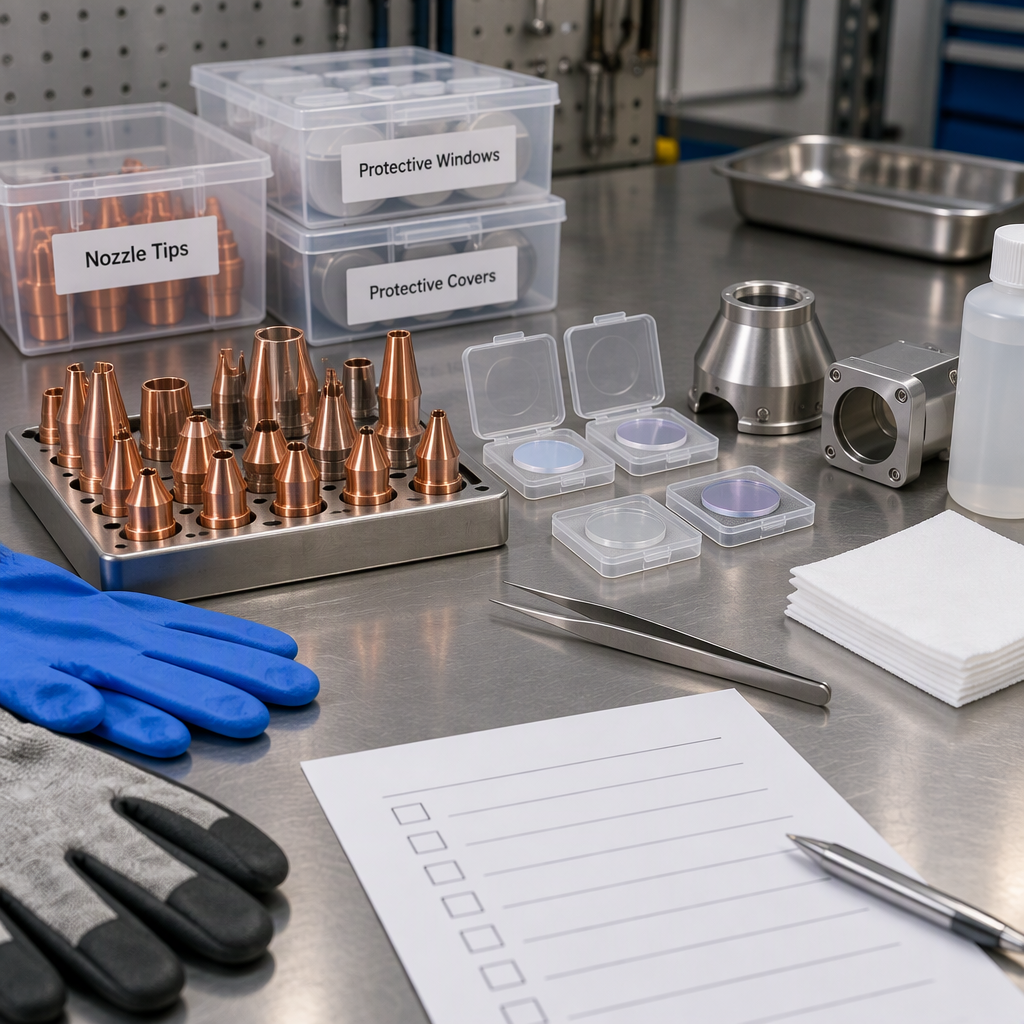
Treat consumables as the parts in the weld head and support path that are expected to wear, become contaminated, or be changed as part of routine operation.
Beam-path protection items
A published parts listing for a handheld laser welding system identifies protective windows, a replacement focus lens, and welding-head protective covers among service parts or consumables for that system.
For your own equipment, confirm the exact protected optical elements, cleaning method, and replacement part numbers in the machine documentation.
Nozzle and front-end items
The same type of manufacturer listing identifies nozzle tips as parts or consumables for a handheld laser welding system.
Nozzle condition matters because the front-end setup helps maintain the physical relationship between the weld head, shielding flow, and workpiece.
For a buyer or process engineer, the practical list should include the parts your team handles repeatedly: nozzles, protective windows, lenses where user service is permitted, covers, gas-path items, wire-feeding contact points if applicable, and any fixture or accessory items named by the supplier. Do not assume another brand’s parts list applies to your machine.
When should operators inspect consumables?
Inspect consumables on the schedule in the machine manual and also after any event that could change weld quality, beam delivery, shielding, or acceptance results.
- Inspect before a new job when the material, thickness, joint design, filler wire, shielding setup, or acceptance requirement changes.
- Inspect after a collision, abnormal sound, unstable arc-like plume behavior, unexpected spatter, poor bead appearance, or a sudden rise in rework.
- Inspect before a long production run so a low-cost consumable issue does not become a batch-level downtime event.
- Inspect after cleaning, replacement, or adjustment to confirm that the head is assembled correctly and the process returns to the approved setup.
- Inspect when operators report reduced visibility, contamination near the front window, gas-flow irregularity, or repeated starts and stops.
A fixed calendar interval is useful only when it comes from your equipment documentation and operating history. In mixed sheet-metal and tube-processing shops, condition-based triggers are often more useful than a single universal cycle because jobs can vary by material, thickness, joint access, fixture stability, and production length.
How to organize a laser welding consumables maintenance workflow
Use a short workflow that separates safe access, visual inspection, permitted cleaning, replacement, setup confirmation, and recordkeeping.
- Before manual access to the weld head, switch off the equipment and disconnect the applicable power source or battery according to the machine manual and site lockout procedure.
- Let trained personnel open only the access points the manual permits; do not bypass guards, interlocks, covers, or laser-safety controls.
- Check the visible condition of nozzles, protective windows, covers, gas passages, wire-feed contact areas, and any removable front-end items named by the supplier.
- Clean only with the approved method, approved tools, and approved consumables for that model; if the manual does not permit cleaning, replace the part or escalate to service.
- Reassemble with the specified orientation, fit, and seating method from the manual, then verify shielding, alignment, and trial weld results before production release.
- Record the part changed, reason for action, job conditions, operator observation, and acceptance result so repeated issues can be traced.
Do not turn consumable maintenance into unsanctioned machine servicing. If a part requires disassembly beyond the manual, stop and involve the supplier or qualified service personnel.
When to replace instead of clean or adjust
Replace a consumable when it is damaged, contaminated beyond the approved cleaning method, unable to seat correctly, or unable to support the required weld result after permitted adjustment.
| Observation | First action | Replace when |
|---|
| Dust, smoke residue, or light surface contamination | Use the manual-approved cleaning method | Cleaning is not permitted, contamination remains, or the acceptance weld still fails |
| Cracked, burned, pitted, warped, or scratched item | Stop production use and compare against the manual’s rejection criteria | The damage affects the protected optical path, nozzle condition, fit, or safety function |
| Loose fit, incorrect seating, or repeated movement | Reinstall only as specified by the supplier | The part cannot seat securely or the retaining feature is worn |
| Weld appearance changes after a job change | Confirm setup, gas, wire, material, and fixture condition | A known-good setup does not recover after permitted cleaning or adjustment |
Clean or adjust
Choose this route when the manual permits the action, the part has no rejection-level damage, and the trial weld returns to the qualified result.
Replace or escalate
Choose this route when the part is physically damaged, the cleaning method is uncertain, a fit problem repeats, or acceptance cannot be restored.
Match inspection to material, thickness, process, and acceptance checks
Increase inspection discipline when job conditions change, because materials, consumables, base metal, and the work environment can change welding exposure and process behavior.
- NIOSH states that welding fume exposure can vary with factors such as welding consumables, materials, and base metal.
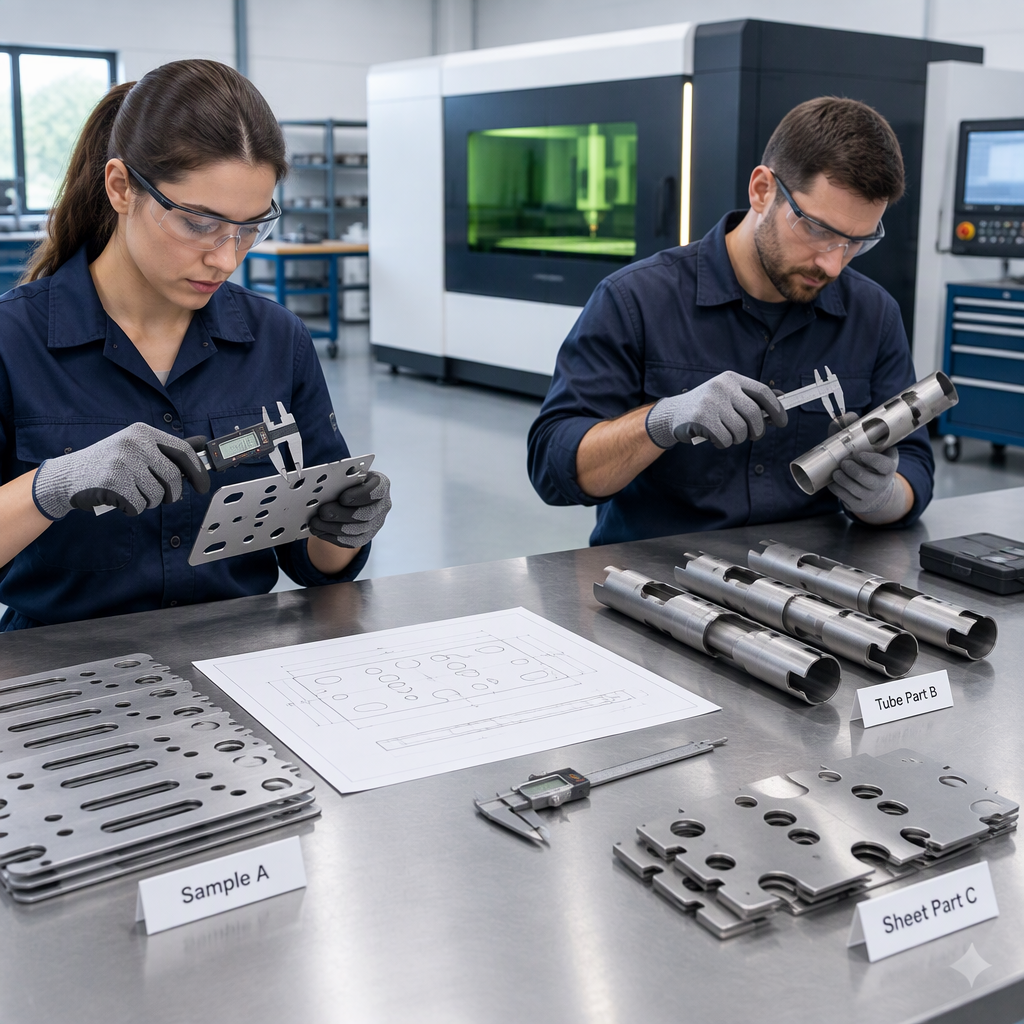
- For sheet-metal work, review consumables when switching alloy, coating, thickness, joint access, or cosmetic acceptance level.
- For tube processing, review front-end condition when circumference, fit-up, fixture repeatability, access angle, or shielding coverage changes.
- For cutting-to-welding workflows, connect the inspection plan to edge condition, cleaning before welding, auxiliary gas history, and the acceptance criteria for the finished weld.
- Before releasing production, make a representative trial weld and check it against the drawing, customer acceptance requirement, internal work instruction, or qualified procedure.
Procurement teams should ask suppliers for a consumables list that maps part names to applications, permitted maintenance actions, and replacement criteria. Process teams should then connect that list to the materials and thickness ranges actually run in the factory.
Safety checks to keep with the consumables routine
Keep consumable inspection inside the site safety system: isolate energy before manual access, maintain fume controls, and follow the applicable laser, welding, and local workplace requirements.
Before touching or opening any weld-head area, switch off the equipment and disconnect the applicable power source or battery according to the manual and site procedure. Do not rely on a general maintenance checklist as a substitute for energy isolation.
The CDC/NIOSH page on welding fumes and manganese states that welding fumes are composed of metals, may contain manganese, and can vary with welding consumables, materials, base metal, and work conditions.
NIOSH also notes that confined-space welding can increase exposure to manganese fumes, so enclosed fixtures, tanks, tubes, or restricted work areas deserve additional review.
NIOSH describes welding operations as producing gaseous and aerosol by-products and gives fume-extraction guns connected to exhaust and filter systems as an example of engineering controls for welding fumes.
For laser welding cells, handheld stations, and tube-processing areas, confirm the actual control method with the equipment manual, the facility safety file, and the rules adopted in the destination country or region.
How to reduce downtime from consumable problems
Reduce downtime by treating consumables as planned production inputs, not emergency spare parts.
- Create a machine-specific consumables list with approved part numbers, minimum stock levels, storage requirements, and responsible personnel.
- Keep clean storage for optics-related items and separate damaged, suspect, and new parts so they are not mixed during a shift.
- Link replacement records to job type, material, thickness, operator notes, and acceptance results to identify repeat causes.
- Train operators to stop early for abnormal weld behavior instead of continuing until a batch fails inspection.
- Review recurring replacement events against fixtures, edge preparation, shielding setup, gas quality, wire feed, and production handling.
- Use the manual for exact intervals and methods.
- Use condition and acceptance results for day-to-day decisions.
- Use records to separate normal wear from process problems.
Conclusion
The best replacement rule is manual-first and condition-based: inspect before risk increases, clean only when approved, replace when condition or acceptance results require it, and record enough detail to prevent repeat downtime.
For sheet-metal and tube-processing factories, laser welding consumables maintenance works best when procurement, process engineering, operators, and safety personnel use the same decision path. Define the consumables, inspect around process changes, protect workers during access, confirm acceptance after any action, and keep customer-specific intervals tied to the official documentation for the machine in use.
FAQs about laser welding consumables maintenance
These questions help buyers and process teams turn consumable inspection into a practical factory routine.
Can I use one universal replacement cycle for every laser welding consumable?
No. Use the machine manual, actual job mix, consumable condition, and acceptance results. A universal cycle can lead to premature replacement in one process and late replacement in another.
Should consumables be checked before every shift?
Follow the equipment documentation. Many factories also use a brief pre-shift visual check for obvious contamination, fit problems, missing covers, or stock issues because it is faster than stopping mid-run.
How do operators know whether to clean or replace a protective item?
Clean only when the manual allows it and the part has no rejection-level damage. Replace or escalate when damage, contamination, poor seating, or failed acceptance remains after permitted action.
Why does a material or thickness change affect consumable inspection?
NIOSH states that welding fume exposure can vary with welding consumables, materials, and base metal; process teams should also expect job changes to affect inspection priorities and acceptance checks.
Which spare consumables should purchasing keep in stock?
Start with the machine-specific list from the supplier, then set stock levels from actual usage, lead time, job criticality, and the cost of stopping a qualified production run.
What should be checked after a consumable is replaced?
Confirm correct seating, approved setup, shielding or assist conditions, trial weld appearance, and the acceptance criteria required by the drawing, work instruction, or customer specification.
What safety step comes before manual access to the weld head?
Switch off the equipment and disconnect the applicable power source or battery according to the machine manual and site procedure before touching or opening the permitted access area.