


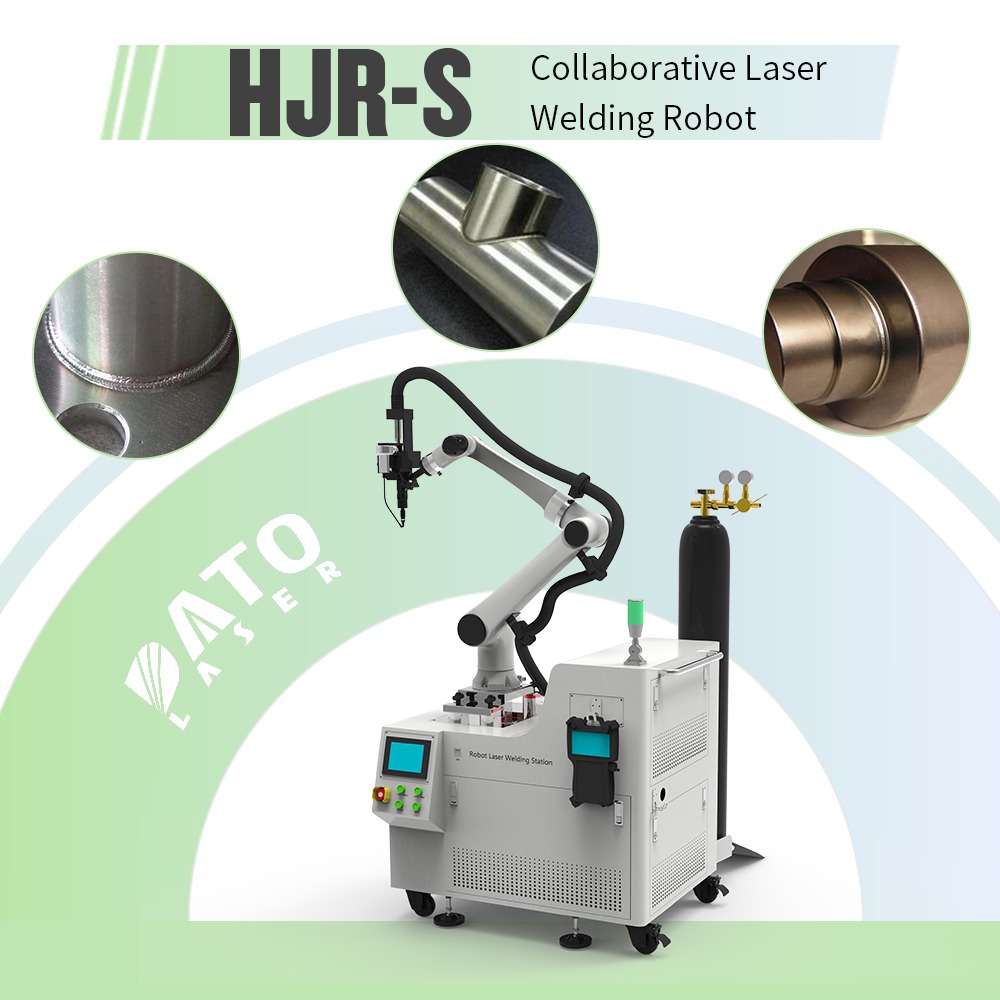


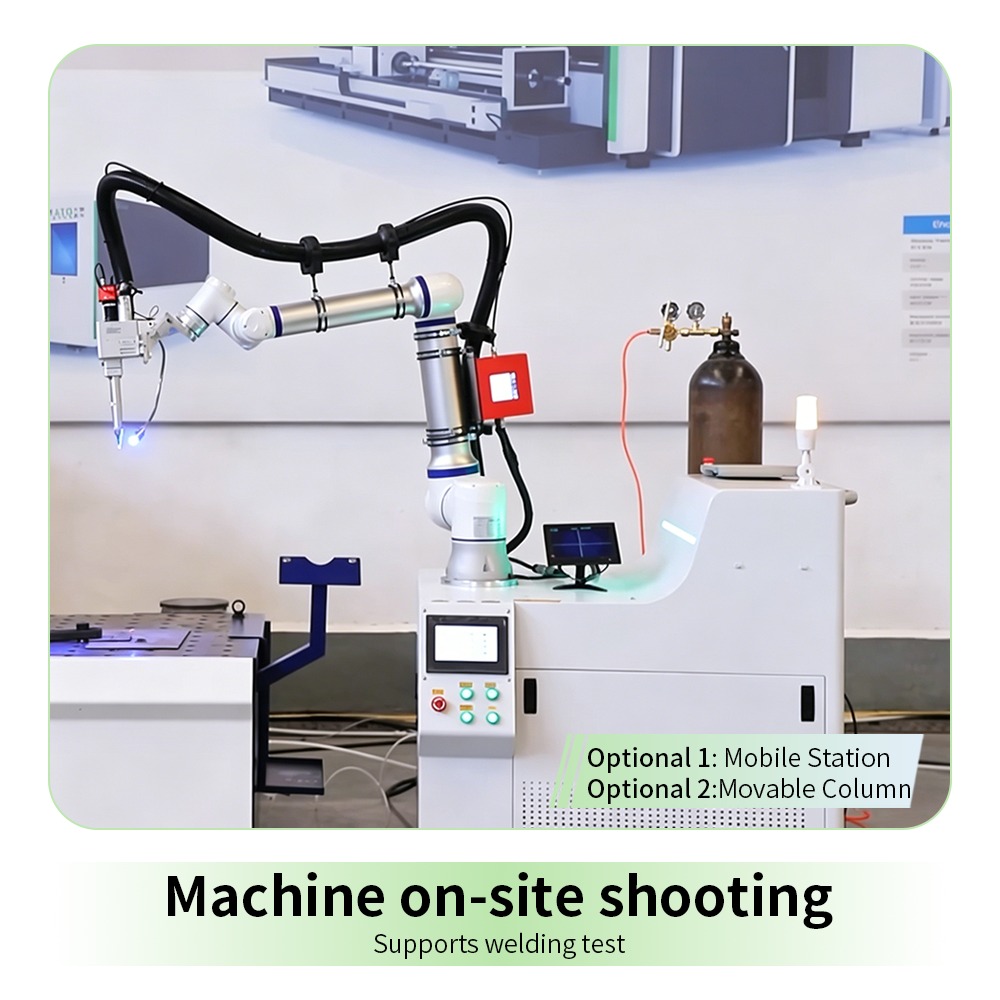


What Is the HJR-S Collaborative Robot Laser Welding Machine?
The HJR-S is a collaborative robot laser welding machine for automated metal welding. It uses a 6-axis robot arm to guide the laser welding head along programmed welding paths, helping manufacturers reduce manual welding variation and improve repeatability in batch production.
Compared with traditional manual welding, the HJR-S is better suited for repeated parts, multi-angle welding, circular seams, straight seams and components that require stable weld width and controlled heat input.
Buyer Pain Points and HJR-S Solutions
Customer Challenge
HJR-S Solution
Inconsistent manual welding quality
6-axis collaborative robot provides repeatable welding paths
Difficulty finding skilled welders
Touchscreen control and preset welding patterns simplify operation
Different materials and thicknesses
1500W, 2000W and 3000W laser power options cover different welding needs
Poor seam width control
SUP25A dual-motor galvanometer welding head supports 0-5mm adjustable weld width
Need real-time seam observation
CCD industrial camera supports seam monitoring during welding
Limited workshop space
Compact mobile station design, starting from 1130 x 920 x 1100mm without robot
Different filler wire requirements
Single wire feeder supports 0.8 / 1.0 / 1.2 / 1.6mm wire diameter
Key Advantages
6-Axis Collaborative Robot for Flexible Welding
The 6-axis collaborative robot can weld from different angles and positions, making it suitable for flat welding, vertical welding, circular welding and complex workpiece shapes. It is useful for factories producing mixed metal parts or repeated components.
SUP25A Dual-Motor Galvanometer Welding Head
The SUP25A welding head uses a dual-motor galvanometer system to support adjustable weld width from 0 to 5mm. This helps operators control seam width, penetration and heat input for different welding requirements.
CCD Industrial Camera for Seam Monitoring
The CCD industrial camera helps operators observe the welding seam during operation, supporting better process visibility and reducing the risk of undetected welding deviation.
6 Preset Welding Patterns
The HJR-S supports 6 welding patterns for different seam types and production tasks. Operators can select suitable welding modes according to the workpiece shape, material and welding requirement.
Multi-Material Welding Capability
The machine can weld carbon steel, stainless steel, galvanized sheet, aluminum alloy and brass. With adjustable power and wire feeding, it can be configured for different materials and thicknesses.
Compact Mobile Welding Station
The welding station is designed for flexible workshop use. The 1500W / 2000W version starts from 1130 x 920 x 1100mm without robot, while the 3000W version is 1450 x 920 x 1100mm without robot.
Machine Configuration
The HJR-S automatic laser welding station can be configured with robot arm, MAX laser source, S&A water chiller, SUP25A welding head, 10.2-inch touchscreen control system, CCD industrial camera and single wire feeder.
Component
Configuration
Robot
6-axis collaborative robot
Laser Source
MAX fiber laser
Cooling System
S&A water chiller
Welding Head
SUP25A welding head and system
Galvanometer Motor
Dual motor
Seam Monitoring
CCD industrial camera
Wire Feeder
Single wire feeder for automatic welding
Control
Touchscreen control system
Welding Patterns
6 types
HJR-S Technical Specifications
Item
1500W / 2000W Version
3000W Version
Model
HJR-S
HJR-S
Laser Brand
MAX
MAX
Water Chiller
S&A
S&A
Welding Head & System
SUP25A
SUP25A
Galvanometer Motor
Dual motor
Dual motor
Welding Patterns
6 types
6 types
Seam Monitoring
CCD industrial camera
CCD industrial camera
Wire Feeder
Single wire feeder
Single wire feeder
Weldable Materials
Carbon steel, stainless steel, galvanized sheet, aluminum alloy, brass
Carbon steel, stainless steel, galvanized sheet, aluminum alloy, brass
Wire Diameter
0.8 / 1.0 / 1.2 / 1.6mm
0.8 / 1.0 / 1.2 / 1.6mm
Power Adjustment Range
300-1500W / 300-2000W adjustable
300-3000W adjustable
Weld Width
0-5mm adjustable
0-5mm adjustable
Equipment Size Without Robot
1130 x 920 x 1100mm
1450 x 920 x 1100mm
Equipment Weight Without Robot
165kg
195kg
Wooden Case Size Without Robot
1250 x 1050 x 1300mm
1250 x 1050 x 1300mm
Package Weight Without Robot
230kg
270kg
Power Supply
1P 220V / 50Hz
3P 380V / 50Hz
Suitable Materials and Applications
Weldable Materials
Carbon steel

Stainless steel

Galvanized sheet

Aluminum alloy
Brass

Copper-based materials depending on process testing
Typical Applications
Sheet metal parts
Stainless steel products
Kitchen equipment
Metal cabinets
Furniture frames
Automotive components
Hardware parts
Electrical enclosures
Pipe and tube components
Small and medium batch metal fabrication
Best For
The HJR-S is best for factories that weld repeated metal parts, need more consistent weld appearance and want to reduce dependence on fully manual welding.
Not Ideal For
The HJR-S may not be the best option for highly irregular one-off parts, unstable workpiece positioning or welding jobs that cannot be fixed or guided by a repeatable robot path.
Collaborative Robot Welding vs Handheld Laser Welding
Item
HJR-S Collaborative Robot Laser Welding
Handheld Laser Welding
Best For
Repeated parts and automatic welding
Flexible manual welding
Welding Path
Robot-controlled
Operator-controlled
Consistency
Higher repeatability
Depends on operator skill
Setup
Requires fixture and programming
Lower setup requirement
Production Type
Batch production
Small batch, repair, flexible jobs
Operator Demand
Easier for repeated tasks after setup
Requires steady manual operation
Investment
Higher
Lower
Why Choose DATO HJR-S?
DATO HJR-S is designed for manufacturers that need a practical automatic laser welding solution without building a large fixed robotic welding cell. The compact mobile station, adjustable laser power, SUP25A welding head, CCD seam monitoring and 6-axis collaborative robot make it suitable for workshops that need flexibility, epeatability and easier operation.
Key reasons:
● Compact mobile station for flexible workshop layout
● 1500W, 2000W and 3000W power options
● 0-5mm adjustable weld width
● 0.8-1.6mm wire feeding support
● CCD seam monitoring for better process visibility
● S&A water cooling for stable long-term operation
● Suitable for multiple metals and welding tasks
Safety and Operation Notes
Laser welding requires proper safety protection. Operators should use laser protective eyewear, follow machine safety instructions and keep non-authorized personnel away from the welding area.
For production environments, DATO can recommend suitable protection measures according to the workstation layout, including safety enclosure, warning light, fume extraction, emergency stop and laser safety training.
FAQ
What is the HJR-S Collaborative Robot Laser Welding Machine used for?
The HJR-S is used for automatic laser welding of metal parts. It is suitable for repeated welding tasks in sheet metal fabrication, stainless steel products, kitchen equipment, hardware parts, automotive components and metal cabinets.
What materials can the HJR-S weld?
What laser power options are available?
Does the machine support wire feeding?
Can the weld width be adjusted?
Is the HJR-S suitable for small workshops?
Is collaborative robot welding better than handheld laser welding?
What information should I provide before quotation?
Get a Custom HJR-S Welding Solution
Send us your material, thickness, workpiece size, seam type and production volume. DATO will help evaluate the suitable laser power, robot configuration, wire feeding setup and welding process for your application.