


Choosing a robotic welding system is not simply a choice between one robot brand and another. The right solution depends on your part size, weight, weld type, batch volume, changeover frequency, available floor space and required automation level.
For many small and medium-sized metal fabrication shops, a collaborative robot (cobot) welding station is the most flexible starting point. For stable, higher-volume production, an industrial robot welding cell usually offers greater speed, reach and payload. For long beams, structural frames, pipes or large workpieces, an industrial robot with a rail track may be the only practical way to reach every weld seam efficiently.
This guide explains the differences, practical applications and selection criteria for all three options—so you can make a more informed investment decision before requesting a robotic welding quotation.
Quick answer:
Choose a cobot welding system for high-mix, low-to-medium-volume production and frequent part changes. Choose a fixed industrial robot welding cell for repeatable, higher-output welding. Choose a rail-mounted industrial robot when your parts are long, large, heavy or require welding across multiple stations.
For an overview of DATO’s laser and sheet metal processing solutions, visit the DATO Laser homepage.
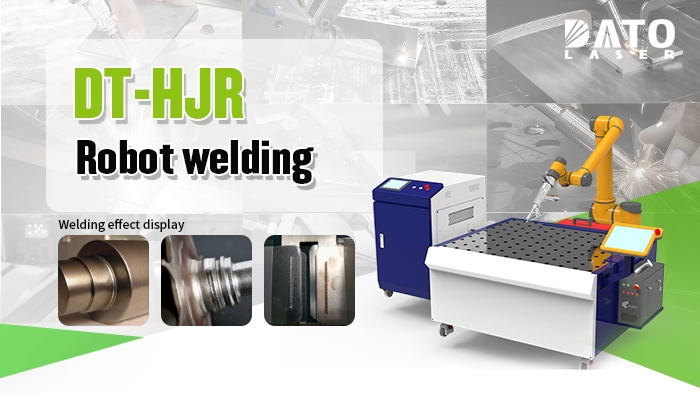
The Three Main Types of Robotic Welding Automation
1.1 Collaborative Robot Welding System
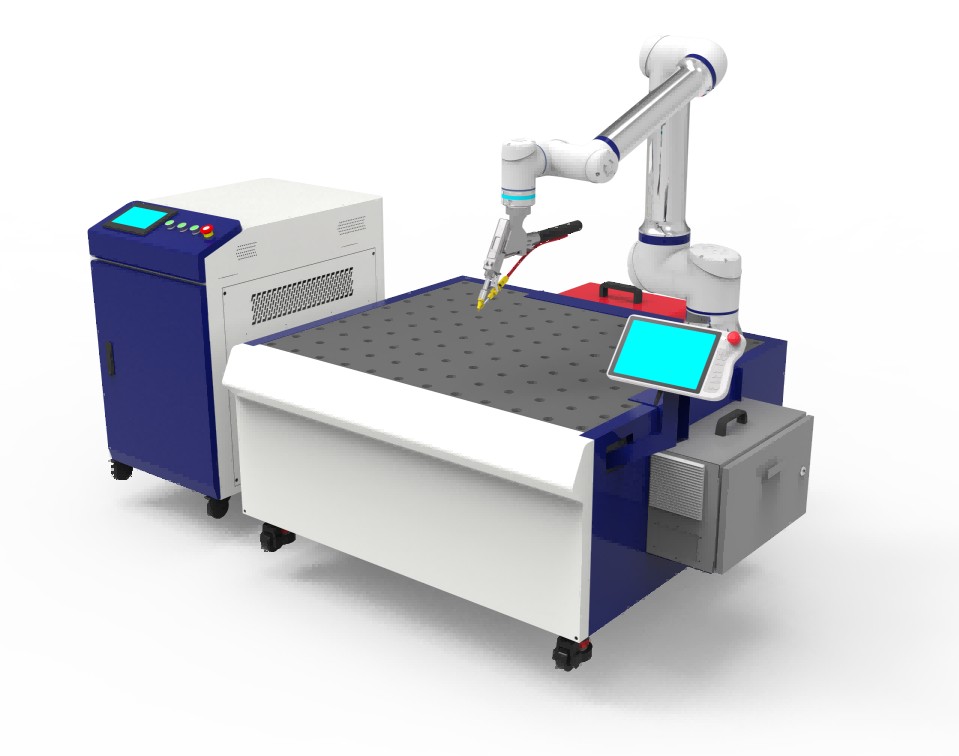
A collaborative robot, commonly called a cobot, is designed to work more flexibly around people than a conventional industrial robot. In welding applications, it can be equipped with a laser welding head, TIG torch, MIG/MAG torch, wire feeder, safety devices and a dedicated welding table or positioner.
A cobot welding station is often selected by manufacturers that have:
Many different part numbers;
Short production runs;
Frequent fixture or program changes;
Limited workshop space;
A shortage of experienced welders;
A need to automate gradually rather than build a large fixed production line.
DATO can configure cobot welding solutions as mobile welding stations, automatic laser welding cells, cobot TIG welding stations and cobot-assisted handheld welding systems. Depending on the part geometry, the workstation can also include a welding platform, fume extraction, safety enclosure or a single-axis or dual-axis positioner.
1.2 Fixed Industrial Robot Welding Cell
An industrial welding robot is typically installed in a fixed cell and is designed for more demanding production requirements. Compared with a cobot, it can usually support higher payloads, longer reach, faster cycle times and more continuous operation.
Industrial robot welding systems are commonly used for:
Structural steel components;
Heavy brackets and machinery parts;
Repetitive production of frames and assemblies;
Long or complex welding paths;
Multi-shift manufacturing;
Large fixtures and heavier workpieces.
A typical industrial robot welding cell may include:
A six-axis industrial robot;
Laser, TIG or MIG/MAG welding equipment;
Welding table and custom fixtures;
Safety fencing or an enclosed cell;
One or more welding positioners;
A robot controller and programming system;
Optional automatic loading and unloading equipment.
1.3 Rail-Mounted Robot Welding System
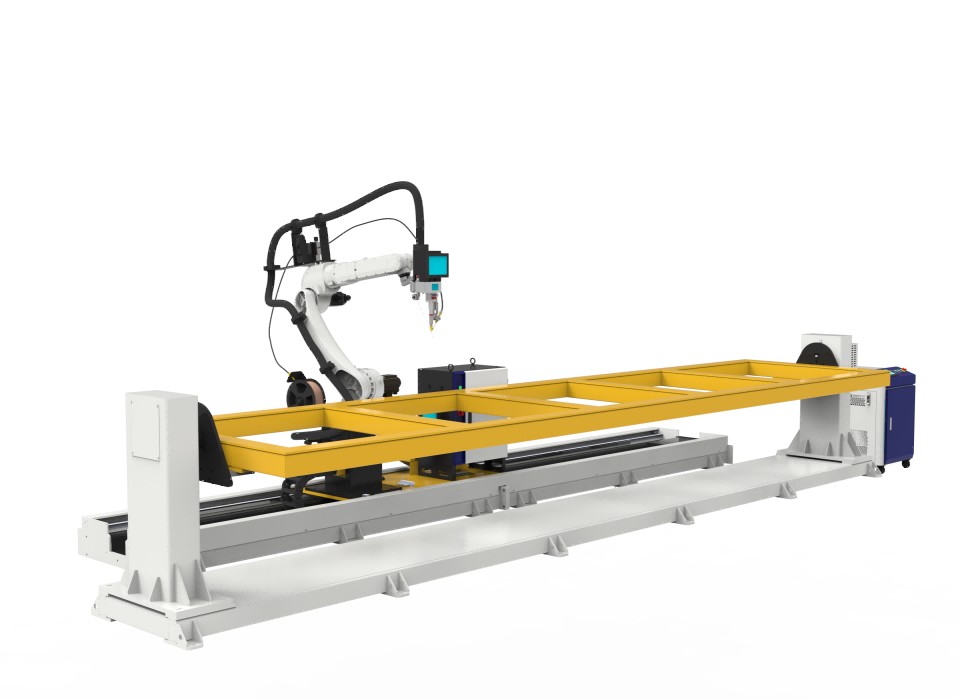
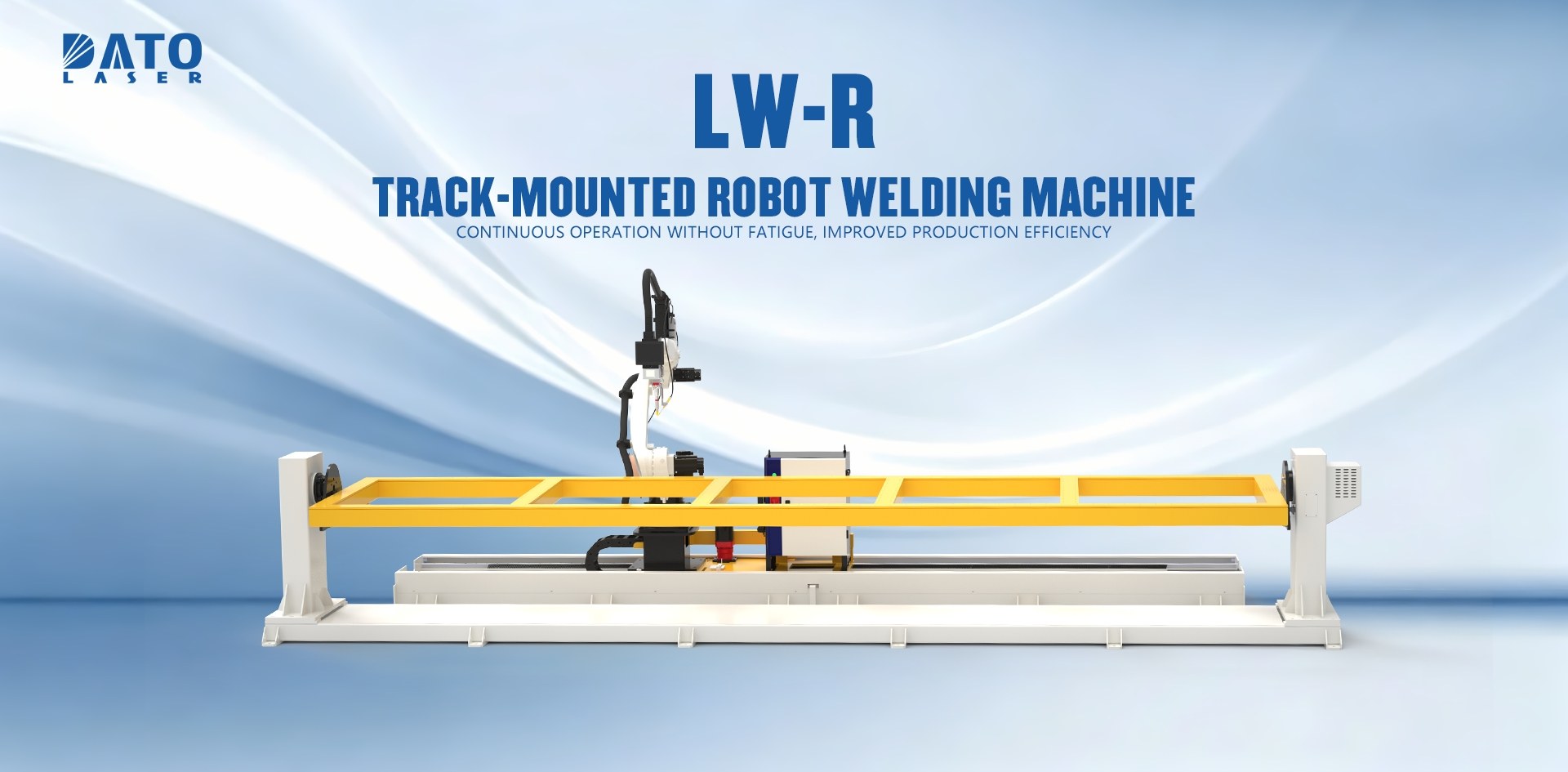
A rail-mounted system—also called a robot welding system with a linear track, ground rail or seventh axis—places an industrial robot on a linear travel rail.
Instead of keeping the robot in one fixed position, the rail allows it to move along the length of the workpiece, fixture or production line. This greatly expands the robot’s effective working envelope.
Rail-mounted robot welding is especially useful for:
Long pipes and tube assemblies;
Steel beams and structural components;
Truck bodies, trailers and chassis parts;
Long metal frames;
Large machinery covers;
Multiple welding stations arranged in a line;
Large parts that cannot easily be moved during welding.
Side-by-Side Comparison: Which System Is Best?
Selection Factor | Cobot Welding Station | Fixed Industrial Robot Cell | Rail-Mounted Industrial Robot |
Best for production volume | Low to medium volume | Medium to high volume | Medium to high volume, especially large parts |
Part mix / changeover | High flexibility | Best for stable, repeatable parts | Suitable for stable large-part production |
Typical workpiece size | Small to medium | Medium to large | Long, large or multi-station parts |
Installation style | Mobile or fixed | Usually fixed | Fixed rail-based installation |
Programming and redeployment | Generally easier and faster | More engineering-oriented | Requires layout and rail planning |
Robot reach | Limited by arm reach | Larger than a typical cobot | Extended by linear rail travel |
Suitable processes | Laser welding, TIG, assisted handheld welding | Laser, TIG, MIG/MAG welding | Laser, TIG, MIG/MAG welding |
Floor-space requirement | Relatively compact | Moderate | Higher; depends on rail length |
Typical buyer profile | Job shops, small factories, high-mix manufacturers | Repetitive production factories | Structural fabricators and large-part manufacturers |
This table is a starting point, not a final engineering recommendation. The final configuration should always be based on your drawings, part weight, weld locations, expected output and workshop layout.
When Is a Cobot Welding System the Right Choice?
A cobot is usually the best choice when flexibility matters more than maximum speed.
For example, a sheet metal fabricator may weld brackets, electrical enclosures, cabinets, frames and custom assemblies in small batches. The parts may change every day or every week. In this situation, investing in a large fixed industrial robot cell may not be the most efficient first step.
A mobile cobot welding station allows the manufacturer to move the system between work areas, change fixtures and automate repetitive welds without redesigning the entire workshop.
Choose a cobot welding system if you have:
High-mix, low-volume or medium-volume orders;
Frequent changeovers between products;
Small to medium-sized parts;
Limited floor space;
A need for simple operator interaction;
Skilled welder shortages;
A goal to automate one welding bottleneck first.
Typical cobot welding applications
Stainless steel kitchen equipment;
Electrical cabinets and enclosures;
Sheet metal brackets;
Metal furniture components;
Small frames and tubular assemblies;
Medical, laboratory or commercial equipment components;
Custom fabrication orders.
For customers comparing workstation layouts, DATO has also published a guide on open vs enclosed robotic welding workstations. An enclosed cell may be appropriate when laser safety, arc-light isolation, fume control or production separation is a priority.
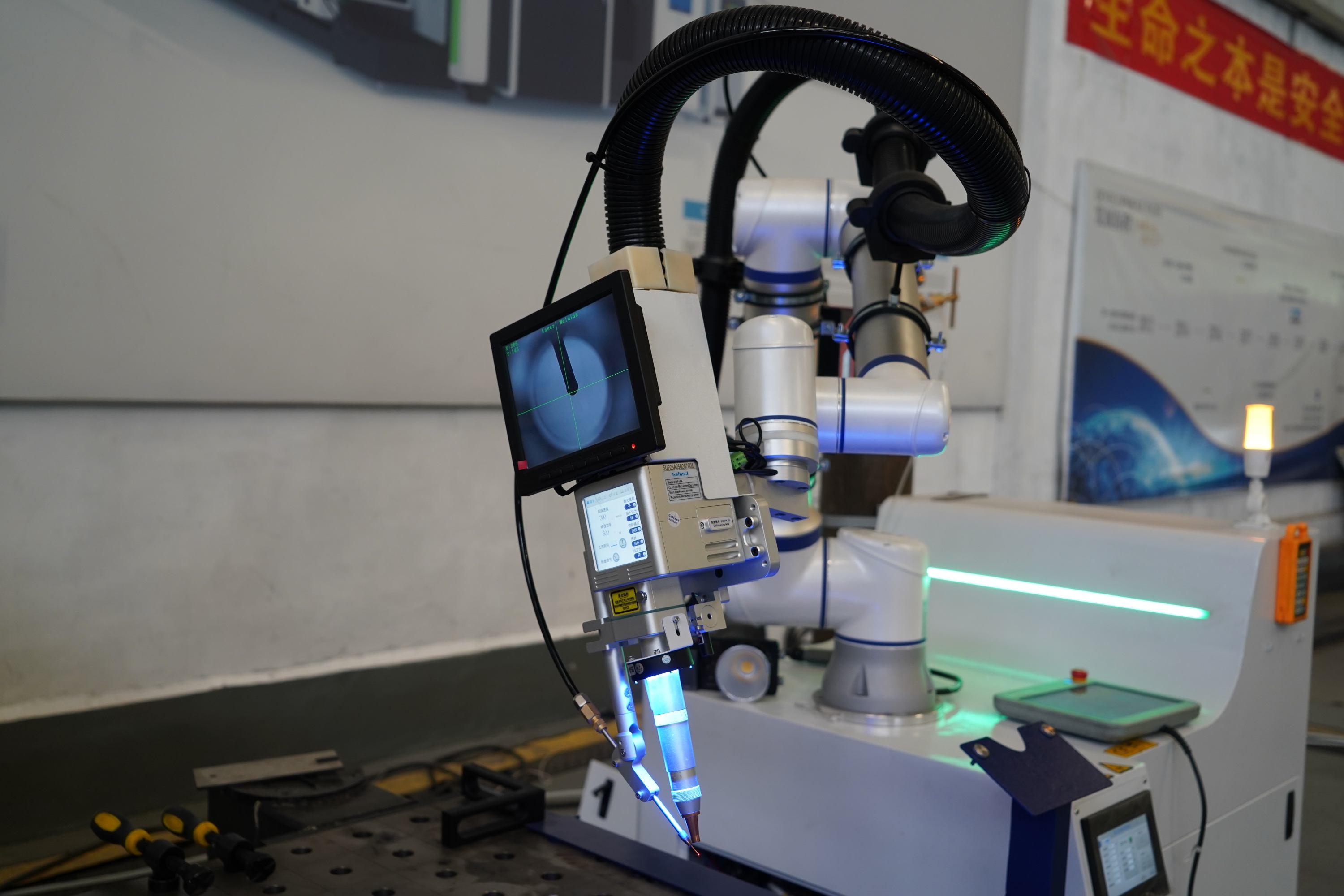
When Should You Choose a Fixed Industrial Robot Welding Cell?
A fixed industrial robot cell is a stronger choice when your factory produces the same or similar parts repeatedly and needs high throughput.
For example, if your company produces hundreds or thousands of similar frames, pipe assemblies, brackets or structural components per month, the higher speed and greater reach of an industrial robot can justify the investment.
The key requirement is consistency. The most successful robotic welding projects usually have:
Repeatable part dimensions;
Stable fixtures;
Predictable weld seams;
Defined quality standards;
Sufficient production volume;
A process that does not require constant manual adjustment.
Choose a fixed industrial robot cell if you have:
Medium-to-high production volume;
Stable part designs;
Repetitive weld paths;
Larger or heavier components;
A requirement for higher duty cycles;
A dedicated welding area;
A clear need to reduce manual welding dependence.
Important consideration: fixture quality
Robotic welding quality depends on more than the robot and welding source. Poor fixture repeatability can cause misalignment, inconsistent gaps and weld defects.
Before automating, evaluate:
Whether the parts are dimensionally consistent;
Whether the joint location is repeatable;
Whether fixtures hold the workpiece securely;
Whether the robot can access the weld in a suitable position;
Whether a positioner can rotate the part to improve access.
When Do You Need a Rail-Mounted Welding Robot?
A robot on a linear rail becomes valuable when the robot must cover a distance beyond its normal arm reach.
For example, a fixed robot may be able to weld one section of a long steel frame but cannot reach the opposite end without moving the entire part. Repositioning a heavy workpiece manually takes time, creates safety risks and interrupts the production cycle.
With a rail-mounted robot, the robot travels along the part instead.
A rail-mounted system is often the right solution when:
The workpiece is long;
The weld seam extends across a large distance;
The workpiece is too heavy or inconvenient to reposition;
One robot needs to serve multiple fixtures;
You manufacture beams, frames, chassis or long tubular structures;
The workshop layout supports a dedicated automation line.
Typical applications
Application | Why a Rail System Helps |
Long structural frames | The robot can travel along the frame instead of moving the frame repeatedly. |
Pipes and tubular structures | The robot can cover multiple weld zones along the pipe length. |
Truck trailers and chassis components | Large dimensions often exceed a fixed robot’s working envelope. |
Steel beams and construction components | Long seam coverage and heavy fixtures favor rail-based automation. |
Multi-station welding lines | One robot can move between stations, depending on cycle-time requirements. |
A rail system is not automatically better for every factory. It requires sufficient floor space, more layout planning and a clear production need. For small parts with frequent changeovers, a mobile cobot or fixed compact cell may provide better overall value.
The Positioner Often Matters as Much as the Robot
Many buyers focus first on robot brand, laser source power or welding speed. However, the welding positioner is often one of the most important parts of a robotic welding solution.
A positioner holds and rotates the workpiece so the robot can access more welds in an optimal welding position.
DATO’s robot welding configurations can be matched with options such as:
Single-axis rotary positioners for circular parts, flanges, rings and cylindrical components;
Dual-axis P-type positioners for parts requiring multi-angle access;
Headstock-tailstock positioners for long pipes, frames, shafts and structural components;
Custom worktables and fixtures for sheet metal, cabinets and assemblies.
Why positioners improve robotic welding results
A correctly selected positioner can help:
Improve weld accessibility;
Reduce the need for difficult out-of-position welding;
Maintain more consistent weld angles;
Reduce manual handling;
Increase robot utilization;
Support more complete welding in one setup;
Improve repeatability from part to part.
Read DATO’s related guide, “Welding Positioner Types for Robotic Laser Welding: How to Choose the Right One for Your Parts,” in our Blog center.

Laser Welding, TIG Welding or MIG/MAG Welding: Which Process Should the Robot Use?
The robot type and the welding process should be selected together.
Robotic laser welding
Robotic laser welding is often chosen for manufacturers that need:
High welding speed;
Low heat input;
Clean weld appearance;
Lower distortion;
Reduced post-processing;
Repeatable welding of sheet metal, stainless steel and precision components.
It is particularly attractive for stainless steel kitchen equipment, cabinets, enclosures, thin-to-medium-thickness sheet metal and precision fabricated parts.
Robotic TIG welding
Robotic TIG welding is often selected when the customer needs:
High visual weld quality;
Precise heat control;
Clean stainless steel or aluminum welds;
A process familiar to an existing TIG-based factory;
More control for thinner materials or demanding weld finishes.
Robotic MIG/MAG welding
Robotic MIG/MAG welding is commonly used for:
Structural steel;
Carbon steel components;
Thick materials;
High-deposition applications;
Frames, machinery parts and larger structures.
The best process depends on the material, thickness, joint design, required appearance, production rate and allowable heat distortion.
DATO has also covered this decision in the article Robotic TIG Welding vs Robotic Laser Welding, which can help buyers understand the process-level differences before selecting a workstation.
How to Choose the Right System: A Practical Decision Checklist
Use the following questions before deciding between a cobot, industrial robot or rail-mounted robot welding system.
Choose a cobot welding station if most answers are “yes”
Do you have many different part models?
Do your batch sizes change frequently?
Are your parts small or medium in size?
Is available floor space limited?
Do you need a mobile or easily redeployed system?
Are you beginning your welding automation journey?
Choose a fixed industrial robot cell if most answers are “yes”
Do you manufacture repeatable parts in medium or high volumes?
Do you need faster cycles and continuous production?
Are your parts too large or heavy for a compact cobot setup?
Can you allocate a fixed area to a robotic cell?
Do you have stable fixtures and repeatable weld locations?
Choose a rail-mounted industrial robot if most answers are “yes”
Are your parts long, large or difficult to move?
Do weld seams extend beyond a fixed robot’s reach?
Do you weld beams, chassis, long pipes or structural frames?
Do you need one robot to serve multiple welding positions?
Can your facility accommodate a linear rail and dedicated automation layout?
Information DATO Needs to Recommend a Welding Automation System
A reliable robotic welding quotation should not be based on a product photo alone. To recommend a suitable solution, DATO’s engineering team typically needs:
Part drawings — PDF, DWG, DXF, STEP or 3D files where available;
Part photos — especially for existing products without complete drawings;
Material type and thickness — stainless steel, carbon steel, aluminum, galvanized steel, etc.;
Part dimensions and weight;
Weld type and weld locations — butt joint, fillet weld, lap joint, pipe seam and more;
Required welding process — laser, TIG or MIG/MAG;
Production volume — per shift, per day, per month or per year;
Part variety and changeover frequency;
Current welding method and key pain points;
Workshop layout, available space and destination country;
Safety requirements — open station, enclosure, fume extraction and local compliance expectations.
With this information, DATO can evaluate whether your project needs a cobot, industrial robot, rail track, welding positioner, custom fixture, safety enclosure or a combination of these components.
Frequently Asked Questions
Q1: Is a cobot welding system always safer than an industrial robot?
Not necessarily. Safety depends on the complete application, including welding process, robot speed, tool, workpiece, fixture, laser or arc hazards, guarding and risk assessment.
For laser welding, protective enclosure, laser safety windows, interlocks and fume extraction may be required depending on the system design and local regulations. For TIG or MIG/MAG welding, arc light, hot workpieces, fumes and moving equipment must also be addressed.
Q2: Can one cobot welding station weld different products?
Yes. This is one of the main advantages of a cobot system. However, each product may still require a suitable fixture, welding program and process parameters. The more repeatable the part positioning is, the more stable the automated result will be.
Q3: Do I need a positioner for robotic welding?
Not always, but a positioner is strongly recommended when the workpiece has multiple welding sides, circular welds, long parts or hard-to-reach seams. It can improve robot access, weld consistency and production efficiency.
Q4: Can a rail-mounted robot weld long pipes or large frames?
Yes. A rail-mounted industrial robot is often used for long pipes, large frames, structural steel and other oversized parts because the robot can travel along the workpiece rather than being limited to one fixed reach zone.
Q5: Which is better for stainless steel: robotic laser welding or robotic TIG welding?
Both can be suitable. Laser welding is often preferred for speed, low distortion and clean, narrow welds. TIG welding is often preferred where the factory requires precise heat control, established TIG processes or specific weld appearance requirements. The correct choice depends on material thickness, joint design, fit-up consistency and desired output.
Q6: Can DATO provide a complete robotic welding solution instead of only a robot?
Yes. DATO can configure an integrated welding automation solution that may include the robot, laser or arc welding equipment, welding head or torch, controller, welding platform, custom fixture, single-axis or dual-axis positioner, headstock-tailstock system, rail track, safety enclosure and technical support.
Q7: Can DATO evaluate our parts before we buy a robotic welding system?
Yes. Send your drawings, part photos, material information, thickness and production target. DATO can review the application and recommend a suitable robot type, welding process, workstation layout and optional positioner configuration.
Plan Your Robotic Welding Project with DATO
The best robotic welding solution is not necessarily the largest robot or the most complex workstation. It is the configuration that matches your actual parts, output requirements, operator workflow and future production plan.
Whether you need a mobile cobot welding station, a fixed industrial robot welding cell, a rail-mounted welding robot, a dual-axis positioner or a headstock-tailstock solution for long parts, DATO can help assess the application before quotation.
Send us your part drawing, material, thickness, weld details, part size and target production volume. Our team can recommend the right robotic welding configuration for your factory.
Explore more welding automation guides and customer projects in the DATO Laser Blog, or visit the DATO Laser homepage to request a machine recommendation.
Related Blogs
-
 In 2026, sheet metal fabricators are under increasing pressure to produce faster, maintain better quality, control labor costs, and respond more efficiently to custom orders. As competition continues to grow in both domestic and global markets, manufacturers are looking for practical ways to improveBuyer's Guide
 -
 For many manufacturers, the biggest equipment decisions are not only about what to buy, but also when to buy. In 2026, September stands out as one of the most practical and strategic months for factories to upgrade production equipment, improve automation capability, and prepare for future growth.WhBuyer's Guide
 -
 Choosing the right equipment is one of the most important decisions a manufacturer can make in 2026. Whether your factory is upgrading a welding line, expanding sheet metal fabrication capacity, or planning a broader automation project, selecting the correct machine affects production efficiency, prBuyer's Guide
 -
 In 2026, more fabricators are investing in CNC press brakes, sheet metal bending machines, and other metal fabrication equipment to improve accuracy, increase output, and build more efficient production lines.During the September Sourcing Sale 2026, DATO LASER gives manufacturers and sheet metal worBlog
