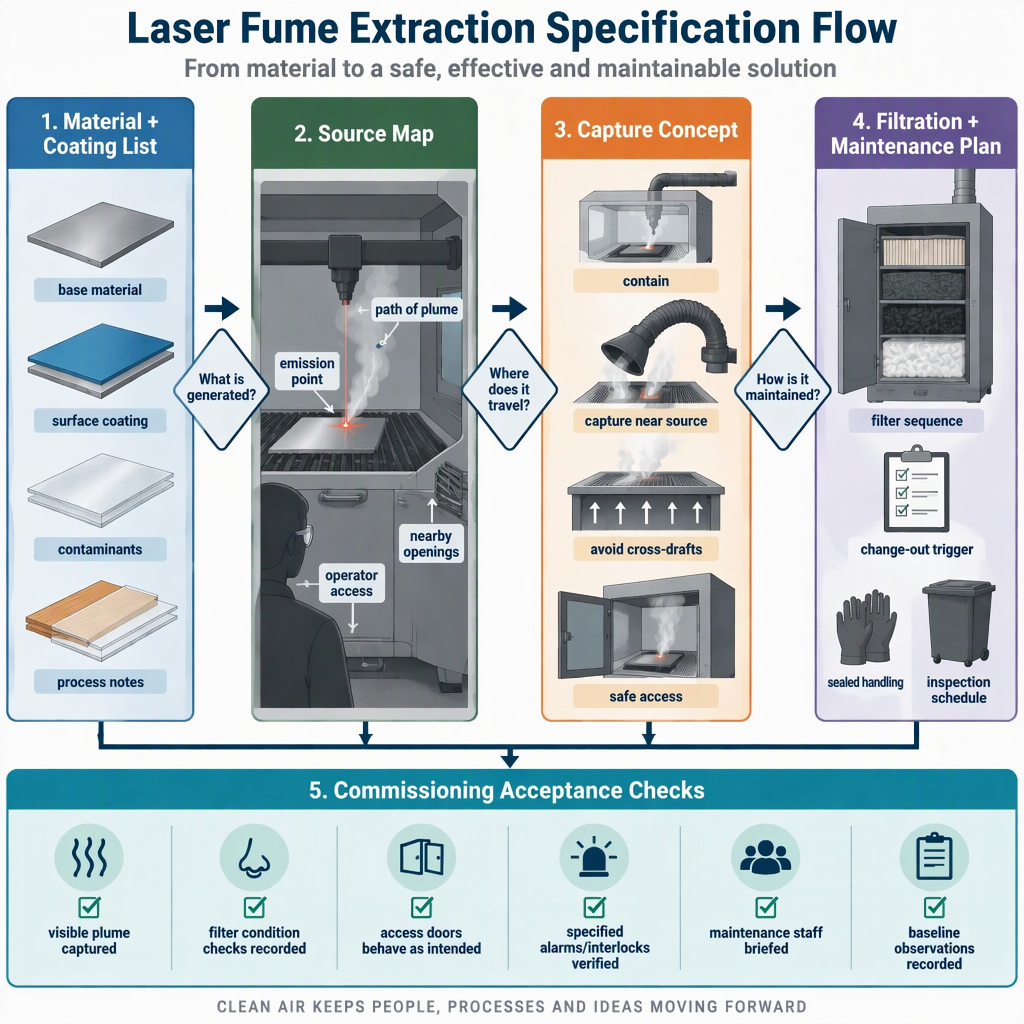
Specify laser fume extraction as an exposure-control package, not as a standalone filter purchase: define the materials, thickness range, coating status, source locations, capture method, filtration and maintenance approach, and commissioning checks before comparing supplier quotations.
What to specify before selecting a laser fume extractor
A useful specification starts with the process and acceptance requirements: what fumes and dust may be generated, where they are released, how they will be captured, and how the installed system will be checked for adequate protection using local exhaust ventilation principles from the HSE guidance on LEV.
Do not begin with fan size or filter marketing terms. Begin with the cutting process, because effective local exhaust ventilation depends on understanding how the process creates airborne contaminant clouds and where those clouds can be controlled.
Specification item
What to record before RFQ
Why it matters
Material family
Metals, polymers, fabrics, coated sheets, mixed production, and any restricted or unusual material.
Laser-generated contaminants can vary by material, so a universal material assumption is risky.
Source mapping shows where contaminant clouds form and where capture should be applied.
Acceptance method
Commissioning records, inspection access, maintenance responsibilities, and repeatable checks after installation.
LEV should be specified with commissioning and adequate-protection checks, not only equipment selection.
Start with the material list, thickness range, and coating risk
Material is the first selection variable because laser cutting different materials can release different particulates and volatile compounds; thickness, coatings, and mixed production should therefore be treated as specification inputs, not afterthoughts.
For metal cutting, HSE identifies processes including laser cutting as producing fumes with health effects similar to welding fume, and it notes that laser cutting is commonly CNC-operated with the operator often at a distance from the fume source.
Material or job condition
How to handle it in the extraction specification
Buyer caution
Routine metal cutting
State the metal families, thickness range, nesting density, duty pattern, and whether the process is enclosed or open during loading.
Remote CNC operation does not remove the need for adequate exposure control.
Polymers, fabrics, or variable non-metal materials
Ask the supplier and site EHS team to review each material and its safety data before approving it for the laser process.
A study of CO2 laser cutting of fabrics and polymers found contaminants varied by material.
Coated, oily, painted, laminated, or unknown stock
Separate these jobs in the material list and require a review before treating them like clean base material.
The contaminant source depends on how the actual process creates airborne material.
Map the fume source around the laser process
Before asking for quotations, map where fume is created, where it travels, and when operators may be nearby; this turns a vague “laser fume extraction” request into a controllable source-capture problem.
In laser metal cutting, the operator may stand away from the cutting point during CNC operation, but exposure can still occur during loading, unloading, inspection, cleaning around the table, filter handling, and work near enclosure openings.
Draw the source points. Mark pierce zones, cutting paths, table sections, tube chuck area, support rollers, open doors, and the scrap or slag collection area.
Record operating states. Separate piercing, continuous cutting, idle extraction, door opening, sheet loading, tube loading, part removal, and post-cut inspection.
Record operator proximity. Note who stands near the machine, when they enter the area, and whether CNC distance is maintained throughout the task.
Convert the map into acceptance points. Ask suppliers how each source point will be controlled and how that control will be checked during commissioning.
Match capture and filtration to the cutting arrangement
The best extraction concept is the one that captures contaminants near the source, fits the laser enclosure and material mix, and includes inspection and maintenance requirements that the plant can actually follow.
Enclosure or table extraction
Use this as the primary concept when fumes are generated inside a defined cutting area and airflow paths can be organized around the source.
Specify how commissioning will show that the enclosure or table extraction gives adequate protection during normal cutting conditions.
Local capture at specific release points
Use source capture when a repeatable release point is known, such as a particular process opening, transfer point, or auxiliary operation.
General source-capture principles from other laser-smoke control settings reinforce that room ventilation should not be treated as the only control when contaminants need to be captured at the point of generation.
General room ventilation as background support
Room ventilation may support overall air management, but it should not replace a specified LEV approach where the process releases harmful airborne substances that need controlled capture.
For metal cutting, exposed operators still need adequate exposure control.
Define commissioning and acceptance before purchase
Acceptance should be defined before purchase: the supplier should state what will be inspected, measured, demonstrated, documented, and handed over when the extraction system is commissioned.
Require commissioning documentation for the installed local exhaust ventilation arrangement, not only a packing list for the extractor.
Ask how the proposed system addresses each mapped fume source and operating state.
Include operator exposure-control checks for metal cutting tasks, including non-cutting moments such as loading and part removal.
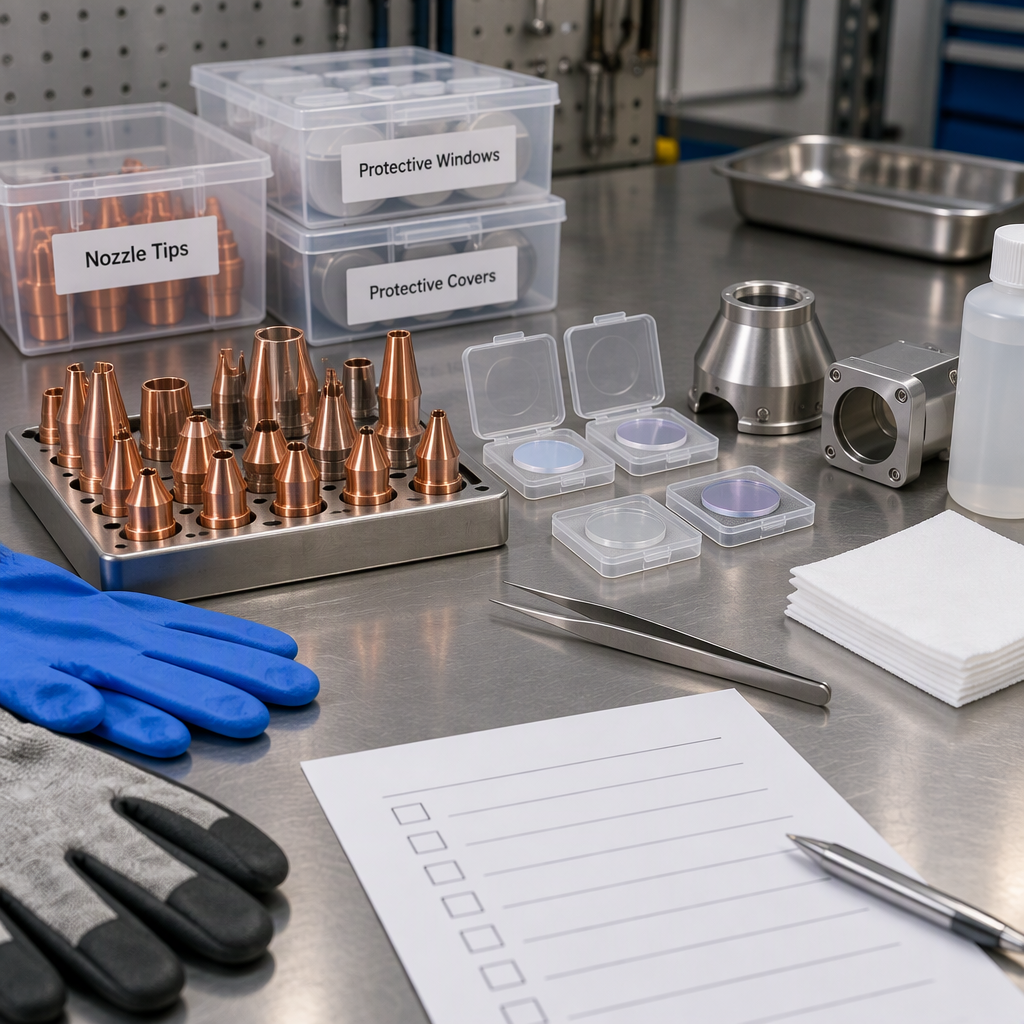
Define routine inspection points, maintenance access, filter-change responsibilities, and records the plant must keep.
Ask what conditions invalidate the original acceptance, such as material changes, enclosure changes, duct changes, or different production patterns.
A purchase specification is stronger when it reflects the HSE framing that LEV is a protective system requiring proper design, commissioning, use, and checks, rather than a one-time equipment purchase.
RFQ checklist for laser fume extraction
Send suppliers a structured RFQ package that describes the process, source locations, materials, operating states, and acceptance expectations; this makes supplier proposals easier to compare and reduces assumptions.
Complete material list, including polymers, fabrics, coated stock, and any customer-supplied unknown materials.
Metal families, thickness ranges, cutting schedule, and whether operators remain distant from the fume source during all routine tasks.
Flat sheet or tube cutting layout, enclosure arrangement, table sections, openings, loading method, and any auxiliary stations.
Required commissioning records, handover documents, inspection points, and maintenance responsibilities.
Local regulatory, occupational hygiene, and site EHS requirements that the supplier must design around.
Expected future changes, such as new materials, thicker work, higher utilization, additional shifts, or enclosure modifications.
Ask each supplier to identify the assumptions behind the proposal. If a proposal does not state material limits, maintenance needs, commissioning checks, and site responsibilities, it is difficult to compare with a more complete laser fume extraction specification.
Conclusion
Choose laser fume extraction by matching the material risk, source map, capture concept, filtration and maintenance plan, and commissioning evidence to the actual cutting process.
Do not assume all materials create the same contaminant profile.
Do not quote extraction without mapping where fume is generated and where people work.
Do not accept equipment selection without commissioning and protection-check requirements.
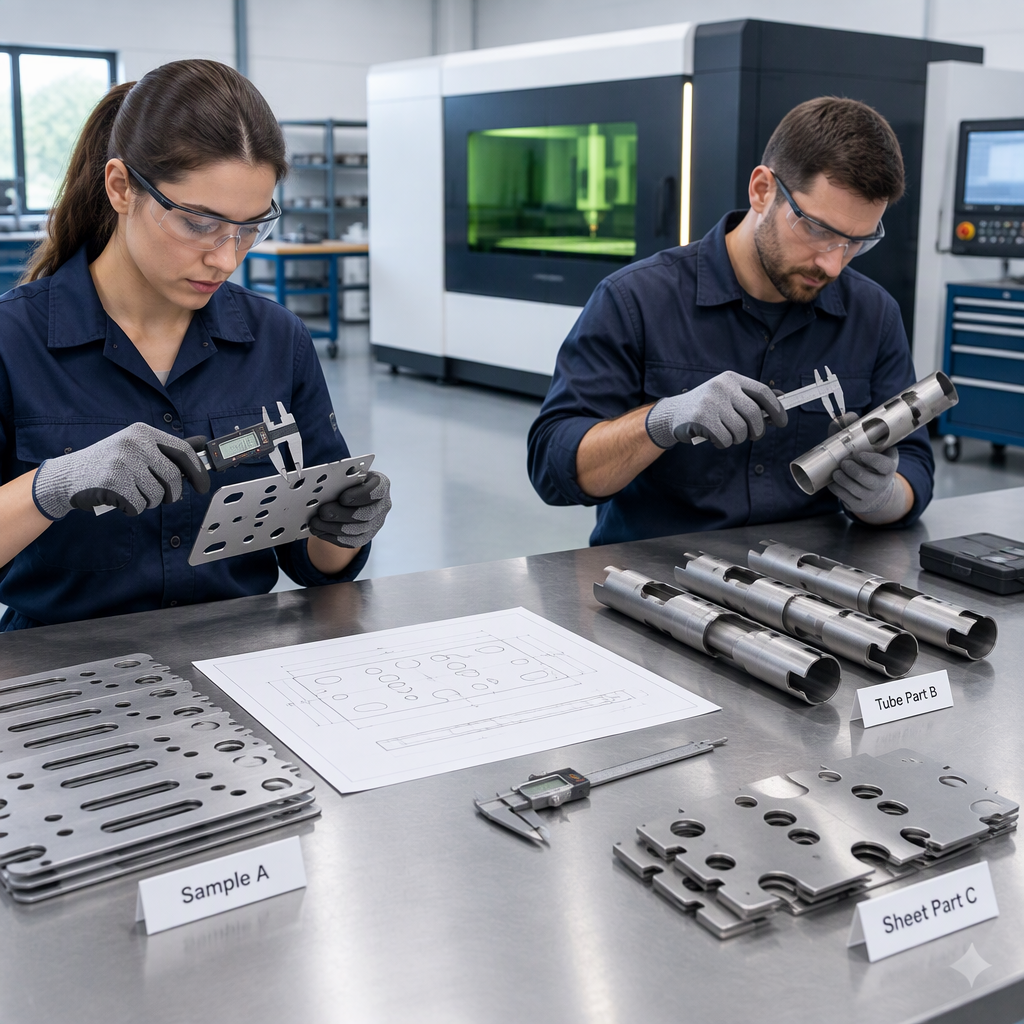
For sheet-metal and tube-processing plants, the practical goal is not to buy the largest extractor by default; it is to define a controlled, maintainable system that fits the material list, cutting arrangement, auxiliary systems, and acceptance standard for the site.
FAQs about laser fume extraction specification
The most useful RFQ questions focus on material suitability, source capture, commissioning, maintenance, and the limits of supplier assumptions.
Can the same extractor be specified for stainless steel, carbon steel, aluminum, acrylic, vinyl, fabric, and coated materials?
Do not assume that one specification covers every material. Laser-generated contaminants can vary by material, so the material list and any coating or polymer review should come before final equipment selection.
Is general workshop ventilation enough for laser cutting fumes?
General ventilation alone should not be treated as the extraction specification where harmful airborne substances are generated; define the LEV approach and acceptance checks for the actual process.
Why does tube cutting need separate review from flat sheet cutting?
Tube cutting can create different source locations, openings, loading positions, and operator tasks, so the source map should be reviewed separately from a flat-sheet table layout.
Should the RFQ include exact airflow or filter-grade numbers?
The RFQ should ask suppliers to justify the design values for the stated process, materials, enclosure, ducting, maintenance plan, and local requirements instead of relying on universal numbers.
What should be checked during commissioning?
Commissioning should confirm that the installed system matches the agreed specification, controls the mapped sources, and provides the inspection and maintenance information needed for continued protection.
Do operators need protection if the laser is CNC-operated?
Yes. CNC operation may place the operator at a distance during cutting, but exposed operators still need adequate exposure control, including during loading, unloading, inspection, and nearby work.
When should the specification be updated?
Update it when materials, coatings, enclosure conditions, ducting, operating states, utilization, or operator tasks change, because the contaminant source and control requirement may also change.
Common Robotic Laser Welding Defects: Causes and Troubleshooting StepsA robot can follow the same weld path thousands of times. That repeatability is valuable—but if a part shifts, a joint gap changes, or a process setting is unsuitable, the robot can also repeat the same defect.The most effective r
Laser Welding Robot vs. Handheld Laser Welder: Which Fits Your Production?Should your factory invest in a laser welding robot or a handheld laser welder? Both use a laser to join metal, but they solve different production problems. A handheld system gives an operator direct control over the welding